


#tiff26: Updated reviews including EVERYBODY WANTS TO F*CK ME, ANCESTORS and more.
https://www.mrwillwong.com/category/tiff/
Updated #tiff26 Reviews include: STUFFED, TRASH NOUNTAIN and CLARISSA.
https://www.mrwillwong.com/category/tiff/

9,906

Mr. Will Wong
Official Fan Page for Toronto Entertainment & Food Personality Mr. Will Wong, multi-award winning Blogger and Photographer.
X: @mrwillw
Instagram +TikTok: mrwillwong

immerse yourself into the world of WILDWOOD at this exhibit from Laika, at Portland Square till 9.19.26. ![]()
![]() WILDWOOD in theatres 10.23.26 via VVS Films
WILDWOOD in theatres 10.23.26 via VVS Films![]()
![]() #tiff #torontointernationalfilmfestival #TIFF26 #wildwood #laika
#tiff #torontointernationalfilmfestival #TIFF26 #wildwood #laika
#tiff26: One of the Festival's biggest breakouts, Anthony Ippolito, who plays Sylvester Stallone in Peter Farrelly's I PLAY ROCKY. A real MVP doing the work going out there and making interactions with new fans. People literally were clapping for him. This is how you do it. 🥊![]()
![]() Pleased to read a lot of praise, a real crowdpleaser. Will it be People's Choice? Thrilled to see it later this week!
Pleased to read a lot of praise, a real crowdpleaser. Will it be People's Choice? Thrilled to see it later this week!![]()
![]() #anthonyippolitp #kikiseto #PeterFarrelly #IPlayRocky
#anthonyippolitp #kikiseto #PeterFarrelly #IPlayRocky
#tiff26: Day Three including:![]()
![]() •Cynthia Erivo at tiff for PRIMA FACIE
•Cynthia Erivo at tiff for PRIMA FACIE![]() •Margaret Qualley, Aaron Pierre and Gabriel Basso at tiff for LOVE OF YOUR LIFE
•Margaret Qualley, Aaron Pierre and Gabriel Basso at tiff for LOVE OF YOUR LIFE![]() •Anna Kendrick and Seth Rogen at tiff for BABIES
•Anna Kendrick and Seth Rogen at tiff for BABIES![]() •Son Suk-ku and Moon Choi at tiff for Bedford Park
•Son Suk-ku and Moon Choi at tiff for Bedford Park![]() •Anthony Ippolito, Kiki Seto, Stephan James and Peter Farrelly at tiff for I PLAY ROCKY
•Anthony Ippolito, Kiki Seto, Stephan James and Peter Farrelly at tiff for I PLAY ROCKY![]() •Lily-Rose Depp, Léa Seydoux and Kelvin Harrison Jr. at tiff for ALPHA GANG
•Lily-Rose Depp, Léa Seydoux and Kelvin Harrison Jr. at tiff for ALPHA GANG![]()
![]() ...and several more!
...and several more!![]()
![]() Brought to you by SoHo Hotel Toronto, the preferred place to stay at tiff!
Brought to you by SoHo Hotel Toronto, the preferred place to stay at tiff!![]()
![]() #torontointernationalfilmfestival #tiff
#torontointernationalfilmfestival #tiff
Have you met Margaret Qualley's dog Smokey?![]()
![]() #TIFF25 #torontointernationalfilmfestival #TIFF26 #MargaretQualley #LoveOfYourLife loveofyourlife
#TIFF25 #torontointernationalfilmfestival #TIFF26 #MargaretQualley #LoveOfYourLife loveofyourlife
lukas dhont
#TIFF26: “COWARD” REVIEW
By Nicholas Porteous for Mr. Will Wong
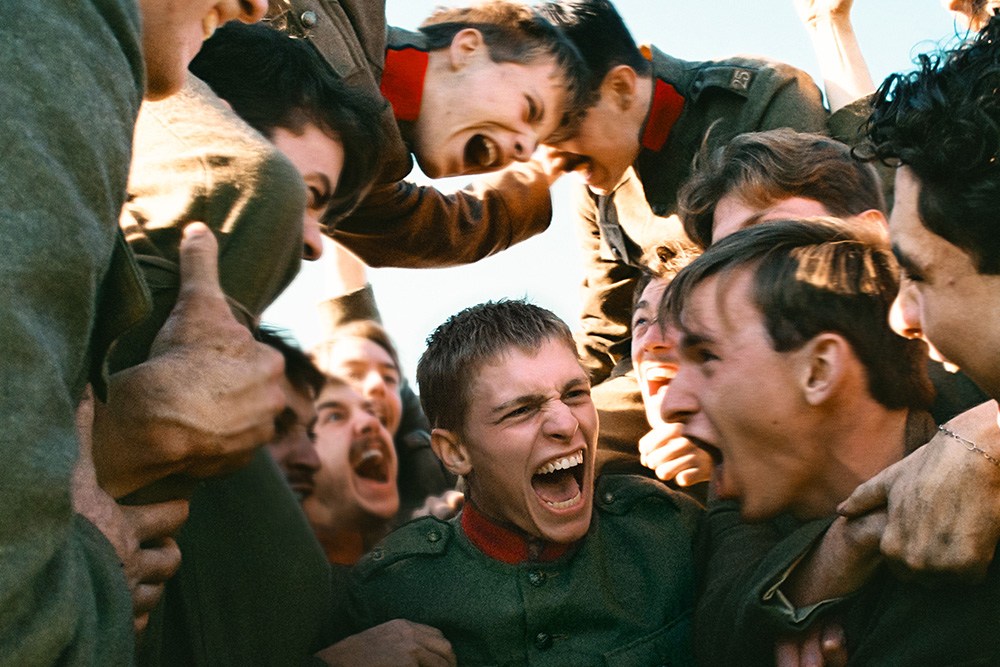
In the first World War, Pierre (Emmanuel Macchia), a Belgian soldier, tries to balance the emotional weight of his horrifying position on the front lines with a blossoming romantic connection to Francis (Valentin Campagne), a theatre kid who motivates the troops with songs and dance. Lukas Dhont‘s Coward is a queer coming-of-age WWI movie, and right off the bat I have to give it props for being such a singular fusion of themes and genres. The look and feel of the trenches is agonizingly sharp and evocative, and makes for a stunning contrast with the beauty of the countryside, and the makeshift theatre and performance spaces.
Dhont‘s vision of a young man torn between love and war is inspired, and the story demands a deep, interior performance from his quiet lead. It is so disappointing that Emmanuel Macchia (in his first film), cannot offer that necessary depth. He has two distinct modes of performance–glum and grinning. Both masks are compelling at first, but as Coward unfolds, the limits of Macchia‘s expressions are unavoidable. It’s all too surfacey and repetitive. In the meta-theatrical sequences, he never even tries to embody the roles he’s signed up for, opting instead to stew in sadness. Your mileage may vary of course, as so much of his performance is wordless, and he is aided by a breathtaking period backdrop and a compelling co-star in Campagne. Not to mention–they shared the Cannes Film Festival Award for Best Actor. There are jurors out there who vehemently disagree with my take. But in a film about performance and masculinity, I needed a lead to match the complexity of his harrowing world. To my mind, the true star of Coward is that aching world itself–and not so much its central inhabitant.
Coward screens at TIFF ’26:
Sun. Sept 13 at 5:45 PM at TIFF Lightbox
Mon. Sept 14 at 5:45 PM at Scotiabank Theatre Toronto
For advertising opportunites please contact mrwill@mrwillwong.com