


#tiff26: Updated reviews include CLUB KID, THE SURGEON, THE DEBUT, I PLAY ROCKY and COWARD.
https://www.mrwillwong.com/category/tiff/

Turf Champions Day on Saturday @WoodbineTB was fantastic and @mrwillw was there to capture the vibe.
#betontario
#tiff26: Updated reviews including EVERYBODY WANTS TO F*CK ME, ANCESTORS and more.
https://www.mrwillwong.com/category/tiff/

9,906

Mr. Will Wong
Official Fan Page for Toronto Entertainment & Food Personality Mr. Will Wong, multi-award winning Blogger and Photographer.
X: @mrwillw
Instagram +TikTok: mrwillwong

immerse yourself into the world of WILDWOOD at this exhibit from Laika, at Portland Square till 9.19.26. ![]()
![]() WILDWOOD in theatres 10.23.26 via VVS Films
WILDWOOD in theatres 10.23.26 via VVS Films![]()
![]() #tiff #torontointernationalfilmfestival #TIFF26 #wildwood #laika
#tiff #torontointernationalfilmfestival #TIFF26 #wildwood #laika
#tiff26: One of the Festival's biggest breakouts, Anthony Ippolito, who plays Sylvester Stallone in Peter Farrelly's I PLAY ROCKY. A real MVP doing the work going out there and making interactions with new fans. People literally were clapping for him. This is how you do it. 🥊![]()
![]() Pleased to read a lot of praise, a real crowdpleaser. Will it be People's Choice? Thrilled to see it later this week!
Pleased to read a lot of praise, a real crowdpleaser. Will it be People's Choice? Thrilled to see it later this week!![]()
![]() #anthonyippolitp #kikiseto #PeterFarrelly #IPlayRocky
#anthonyippolitp #kikiseto #PeterFarrelly #IPlayRocky
#tiff26: Day Three including:![]()
![]() •Cynthia Erivo at tiff for PRIMA FACIE
•Cynthia Erivo at tiff for PRIMA FACIE![]() •Margaret Qualley, Aaron Pierre and Gabriel Basso at tiff for LOVE OF YOUR LIFE
•Margaret Qualley, Aaron Pierre and Gabriel Basso at tiff for LOVE OF YOUR LIFE![]() •Anna Kendrick and Seth Rogen at tiff for BABIES
•Anna Kendrick and Seth Rogen at tiff for BABIES![]() •Son Suk-ku and Moon Choi at tiff for Bedford Park
•Son Suk-ku and Moon Choi at tiff for Bedford Park![]() •Anthony Ippolito, Kiki Seto, Stephan James and Peter Farrelly at tiff for I PLAY ROCKY
•Anthony Ippolito, Kiki Seto, Stephan James and Peter Farrelly at tiff for I PLAY ROCKY![]() •Lily-Rose Depp, Léa Seydoux and Kelvin Harrison Jr. at tiff for ALPHA GANG
•Lily-Rose Depp, Léa Seydoux and Kelvin Harrison Jr. at tiff for ALPHA GANG![]()
![]() ...and several more!
...and several more!![]()
![]() Brought to you by SoHo Hotel Toronto, the preferred place to stay at tiff!
Brought to you by SoHo Hotel Toronto, the preferred place to stay at tiff!![]()
![]() #torontointernationalfilmfestival #tiff
#torontointernationalfilmfestival #tiff
Have you met Margaret Qualley's dog Smokey?![]()
![]() #TIFF25 #torontointernationalfilmfestival #TIFF26 #MargaretQualley #LoveOfYourLife loveofyourlife
#TIFF25 #torontointernationalfilmfestival #TIFF26 #MargaretQualley #LoveOfYourLife loveofyourlife
#TIFF26: “JOSEPHINE” REVIEW
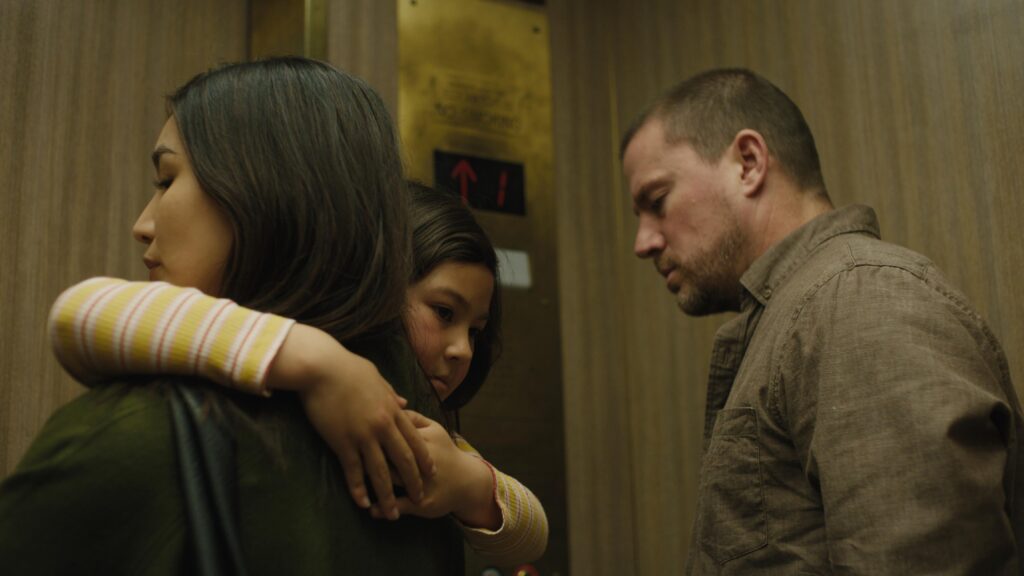
By Nicholas Porteous
Josephine opens with a first-person pov shot from its protagonist–a little girl learning to run and jump with her dad (Channing Tatum). Though the camera leaves this particular setup, Josephine‘s perspective is locked in for the rest of the film. We’re inhabiting the soul of a child in the earliest stages of development, and when she’s the only third-party witness to a sexual assault, her journey becomes as painful as it is impossible to look away from.
Josephine is a profound exploration of how trauma shapes us in immeasurable ways–manifesting in behaviour that often defies easy explanation. Josephine’s parents are intermittently split on how to confront her pain. Her mom (Gemma Chan) wants to go inward, while Tatum’s instinct is to push her physical activity as a ‘distraction’. Their approaches clash, and Josephine is often left to her own devices, drowning in uncertainty and mysterious, unchecked aggression. There are moments when the film’s thesis feels foggy. That dynamic tension between Josephine’s various caretakers that can feel uneven, driven by dialogue that’s a little too sharp for such a delicate and uncertain situation. Most of the time, however, it’s an immersive, deeply felt experience–in the best, and most agonizing, way–straight from director Beth de Araujo’s heart. She’s described the origins of Josephine as partially autobiographical. Considering its uncannily vivid perspective, I’m not at all surprised.
If you miss its final screening at TIFF, I heartily recommend catching Josephine in theatres this November.
Josephine screens at TIFF ’26:
Mon. Sept 14 at 9:20 PM at Scotiabank Theatre
Share This Article
Related Posts
-
 #TIFF26: DAY FOUR SIGHTINGS – JULIANNE MOORE, AMANDA SEYFRIED, LIAM NEESON, JAY BARUCHEL, JORDAN FIRSTMAN, ANDREW SCOTT, BILLIE PIPER AND MORE
-
 #TIFF26: “BABIES” REVIEW
-
 #TIFF26: “WILD HORSE NINE” REVIEW
-
 #REVIEW: “ELSINORE” REVIEW
Leave a Reply
For advertising opportunites please contact mrwill@mrwillwong.com